Music’s Odyssey: An Invitation to Western Classical Music
- Chris Millton
- Oct 5, 2025
- 3 min read
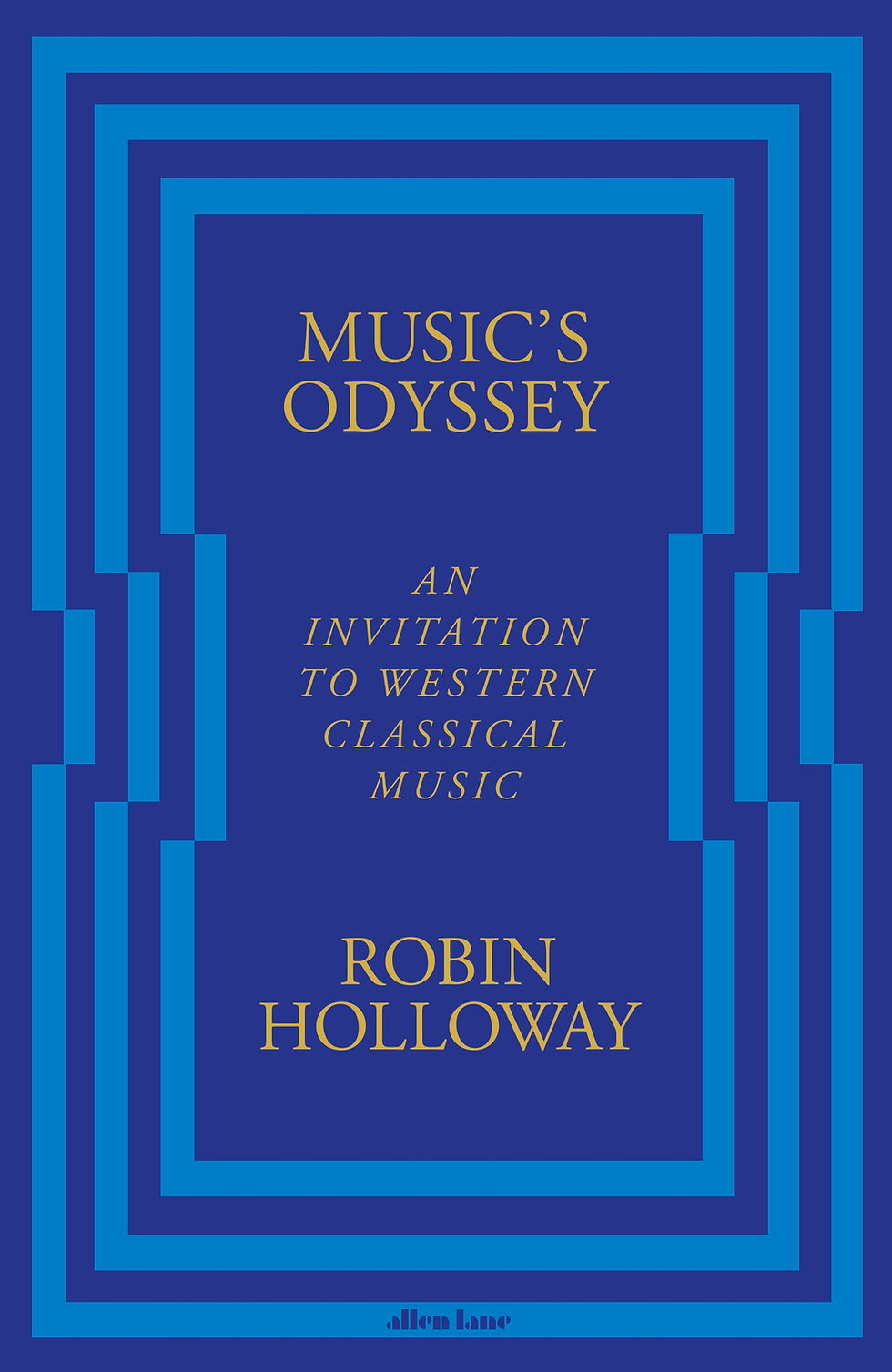
Robin Holloway's Music’s Odyssey: an Invitation to Classical Music is a gargantuan, ambitioux work, its intent to give an account, for the interested layman, of “how music is made – its core practises, skills, conventions, traditions ... of how music works upon its listener, how it moves and stirs”. It’s hard to imagine anyone more suited to write such a work than Holloway, who has lived a long life dedicated to teaching and composing.
The book is not only a paean to Western classical music, but also monument to human energy: this 1000 page plus book being written by an 82-year-old, who begins work each day at 4 am. A Fellow of Gonville and Caius College, Reader in Musical Composition and, before retiring in 20011 a Professor Musical Composition at Cambridge, Holloway is himself a composer of numerous well-regarded works such as Scenes from Schumann (1969-70), Seascape and Harvest (1983-4) and the opera Clarissa (1990), and has previously published on Debussy and Wagner.
Although it covers fourteen centuries of music, its “slow-evolving glory” from 600 to now, and covers all significant names, dates and works, “the real story”, Holloway writes, “begins with Bach”, Bach and Schubert being “the twin centres - the Sun and Moon” - of Holloway’s musical universe. This is not to say that what comes before Bach is covered in a perfunctory way – it’s a very long book. Though chronological, it’s not a history, and is ideally to be read not from cover-to-cover, but is instead “intended for dipping/browsing/skipping”, but too long on detail to be regarded as a quick-reference book.
Despite classical music’s story being “told through specific works and specific composers” Music’s Odyssey is, unlike Alex Ross’s The Rest is Music, extremely light on biographical detail, or accounts of milieus. Holloway is not a musical journalist, and this is an inside job, though it’s not lacking in cultural context, and you’ll get, for instance, illuminating details on how an injunction from The Council of Trent might have affected musical production, or a movement’s points in common with a school of architecture or poetry. There is a glossary of musical terms, and although intended for the common reader I would say that those who can read music or play an instrument will take slightly more from the book. Holloway is a gifted writer. His prose is at times telegrammatic, notational, reminding one of the prose style of novelist Henry Greeen in its eschewing of articles and relative pronouns, and he frequently uses a series of forward slashes resulting in a tone of enthused urgency. Elsewhere, his prose is poetic, but of the clarity-giving kind, not the vague, diffuse and connotative.
Music’s Odyssey is a book of scrupulous, informed appraisal and, though there are no strong aversions on display, is partial, something which principally manifests in how much attention is given to a work or composer: Vivaldi gets a page-and-a-bit, Bach over forty, and we are talked through nineteen of Bach’s works in detail. His judiciousness, giving someone their due, but no more, no less, can be seen in his appraisal of what he calls the ‘Mahler/Strauss nexus’: “Unbelievable fluency, mastery, assurance, confidence, supreme technicians, masters of vulgarity, cliched, shopsoiled bargain basement dregs: absolutely without inhibition, scruple, shame - yet sheer genius and daring originality alongside”, whilst he judges Dvorak as “genial, warm, cheerful, good humoured and abounded in good ideas drawn from music’s well-springs.”
Holloway is unashamed of strong enthusiasms or extravagant praise; of Pfitzner’s Palestrina he writes, “Even when the Mass is sung by humans, one must kneel before such serene perfection”, and Ligeti, he claims, “because of the extreme purity of his stance”, is “an exemplar and icon unmatched in his time”. Although intended to “be read “without getting bogged down in musicology and technicalities”, Music’s Odyssey is studded with insights into the nature of music, some, as with his excursus on the use of irony in art in his discussion of Stravinsky, in the form of philosophical essayettes.
Music’s Odyssey is readable and entertaining, but above all useful, for those who want to plunge for the first time into this vast and various body of work, or to deepen the enjoyment of those already familiar with it, the purpose of which, ultimately, according to Holloway, is to “provide spiritual nourishment”.
Music’s Odyssey: An Invitation to Western Classical Music is published by Penguin in hardcover on 30 October, priced £45



Comments