Kitchen Devils: Against Garlic Presses
Updated: Aug 25
In my callow youth, I owned several garlic presses in succession. I thought they, and garlic itself, sophisticated. Growing up in 1980s rural Lincolnshire cooking suspicious foreign food was something that might land you in a burning Wicker Man, screaming for mercy from jeering, turnip-faced yokels. Now, at the risk of having a contract taken out on me by Alessi or Oxo Good Grips, I would urge anyone in possession of one of these nefarious devices to get rid of it, and to learn to prepare garlic for your dishes without one.
People become very defensive about their garlic presses, accusing their detractors of food snobbery. Whatever evidence you present, they would rather their garlic press be prised from their cold dead hands than give it up. But it’s not only in the kitchens of high-end restaurants where you’ll find no garlic presses, you won’t find them being used in any professional kitchen: a chef who started to use one would be ridiculed, stopped in his or her tracks and, ideally, subjected to a day’s light-to-medium bullying, depending on whether or not they argued the toss. If the purpose of a garlic press, first mass-produced by Ayliss in the 1950s, is to prepare garlic for use in cooking, then it is a failed invention, one that should have stayed on the drawing board and never gone into production.
The pulp that comes from a garlic press burns very easily, more so than any other preparation method, and whether it burns or not, it will impair the flavour of your dish. You can find a detailed scientific explanation in Harold McGee’s On Food and Cooking of what compounds are released and how they interact with each other, but briefly, pressing the garlic through those tiny holes releases a high concentration of allicin and other sulphur compounds, producing a strong, aggressive garlic smell, and a flavour bitter to the point of acridity. Even using a microplane is better, as it cuts rather than squeezes, though what it produces is still too fine for sautéing (I use one for grating garlic into tzatziki).
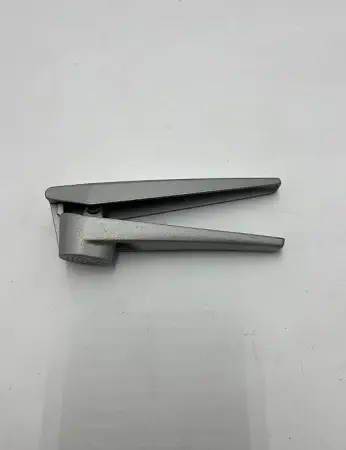
If this is not enough to deter you, the puree produced by a garlic press integrates badly with the other ingredients, or into a sauce, creating small pockets of intense garlickiness, the metals most are made of are reactive, and will impart an extra, unwanted metallic taste to your dish and, finally, they are a pain in the ass to clean.
You don't need advanced knife or culinary skills to do without a garlic press. In professional kitchens that do a lot of covers ready-peeled garlic is minced in a Robocoup and kept in oil. At home, on the rare occasion that you’ll need a great deal of garlic, you could use your food processor. If a recipe, such as that for a marinara sauce, calls for paper thin slices of garlic, you need not use a knife (or, as in Goodfellas, a razor blade) but instead you can use a mandoline or a truffle slicer.
Not letting garlic burn isn’t just a matter of prepping it properly, but also of making sure you sauté it very gently. The same goes for onion, and if you are sautéing garlic with onions, you shouldn’t add the garlic until the onions are beginning to soften (if you want to bring out the sweetness of onions and make them less harsh in flavour add some sea salt to them as they sauté, which breaks down and releases the onion's sugars).
Too high a temperature will not only impair the flavour of your garlic and onions, but also that of your olive oil, if that’s what you’re using. Olive oil has a low smoke point and extra virgin olive oil even more so and, if heated too high, its chemical structure changes and it becomes carcinogenic. (After being in so many kitchens with black-as-midnight oil in their fryers I rarely eat deep fried food when eating out; no doubt this problem got worse as the price of cooking oil went up and up. The danger is not just in the oil itself - the oil browns batter prematurely, leading to the risk of eating undercooked food).
Forget food shows, extra olive oil should be used only for the very gentlest of sautéing and is ideally used only for cold sauces, dressings, tossing things in, and as a finishing oil. Most professional kitchens now use rapeseed oil, as it has a much higher smoke point and is cheaper; even as a finishing oil I think extra virgin rapeseed oil superior, as it is tasteless and has a vibrant, golden yellow colour.
If you do need to finely chop garlic, it’s very easy. Smash the garlic clove under the blade of your knife at the widest point near the handle, with the side of your fist. You can then peel the garlic easily and take out the green root inside, if there is one (if this is root is large, it means that the garlic is old and stale). After removing the skin and root, bash the clove once or twice more and then you can start mincing with your knife. If you need a paste, for instance for aioli, instead of mincing the bashed garlic sprinkle on some sea salt and squash it down firmly with the flat of your knife blade near the tip, then scrape it across your chopping board. Turn your knife over and press and drag in the other direction, repeating until you have a paste. You can also do this in a pestle and mortar. You’ll notice that the resulting paste is quite different to the fetid and odoriferous pus that pops out from your garlic press. A knife with a thin blade and a little flexibility such as a Sabatier 20cm Chef Knife is best for this operation.

There are several ways to impart the taste of garlic to your food without any chopping at all. I make a very quick, easy tomato sauce by cutting a garlic bulb in half and putting the two halves into the chopped tomatoes with a whole bunch of basil – along with seasoning, a teaspoon of sugar, and a tablespoon of oil – and just removing them when the sauce has cooked. This, reduced to the consistency of a thick jam, is also how I make a pizza topping. This sauce fills the house with a wonderful smell: if used correctly garlic is neither stinky nor harsh, but fragrant and sweet.
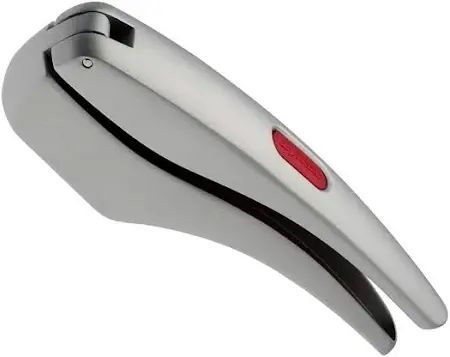
If you’re making a dauphinois or want a garlicky mash, steep peeled cloves in the cream and milk, and rub the sides of the baking dish for the dauphinoise with a cut garlic clove. A simple Tuscan tomato sauce, Pici all ‘aglioe, is made by sautéing 4-6 crushed garlic cloves as gently as possible, then squashing them with the back of a wooden spoon into the oil when they are soft, before adding some pepper flakes and chopped tomatoes.
The way to get the sweetest and least harsh garlic taste is to roast it and use the pulp. You can wrap new potatoes in foil parcels with peeled garlic cloves, seasoning and a little oil, and roast them. The potatoes come out sweet and caramelized, and the garlic can be smeared straight onto them, perfect for a Sunday roast. Alternatively, slice the top off a garlic bulb, cover the top with a little foil, roast, and squeeze out the pulp when done. This pulp can be used to add to a sauce, soup, gravy, or stew, and also acts as a thickener. Mixed with olive oil, it was what we tossed the house potatoes in at Rotorino in Shoreditch (gone now, one of London hospitality’s many victims of Covid), along with some deep-fried rosemary. There, by force of circumstance, taking my turn to prepare staff food, I happened on a delicious pasta sauce, adding this roasted garlic pulp to a tomato sauce along with mascarpone cheese - a pinkish, pretty-coloured sauce that in its creamy sweetness is perfect for pernickety kids.
Better people than me have railed against garlic presses. Marcella Hazan in The Essentials of Italian Cooking wrote: “garlic cloves may be used whole, mashed, sliced thin or chopped fine, depending on how manifest one wants their presence to be. The gentlest aroma is that of the whole clove, the most unbuttoned scent is that exuded by the chopped. The least acceptable method is preparing it through a press. The sodden pulp it produces is acrid in flavour and cannot even be sauteed properly”. Anthony Bourdain, with typical aggression, wrote, “old garlic, burnt garlic ... garlic that has been squashed through one of those abominations, the garlic press, are all disgusting”, whilst Eizabeth David, who refused to stock them in her London shop, described them as “ridiculous and pathetic” in her book Is There a Nutmeg in the House? In short, a garlic press is less than useless, a traitorous saboteur that you should banish from your kitchen for good.
Comments