The Mysteries of the Toddler's Scribble
Updated: Aug 31
“The scribble is the artist’s fundamental rhythm”
Cy Twombly
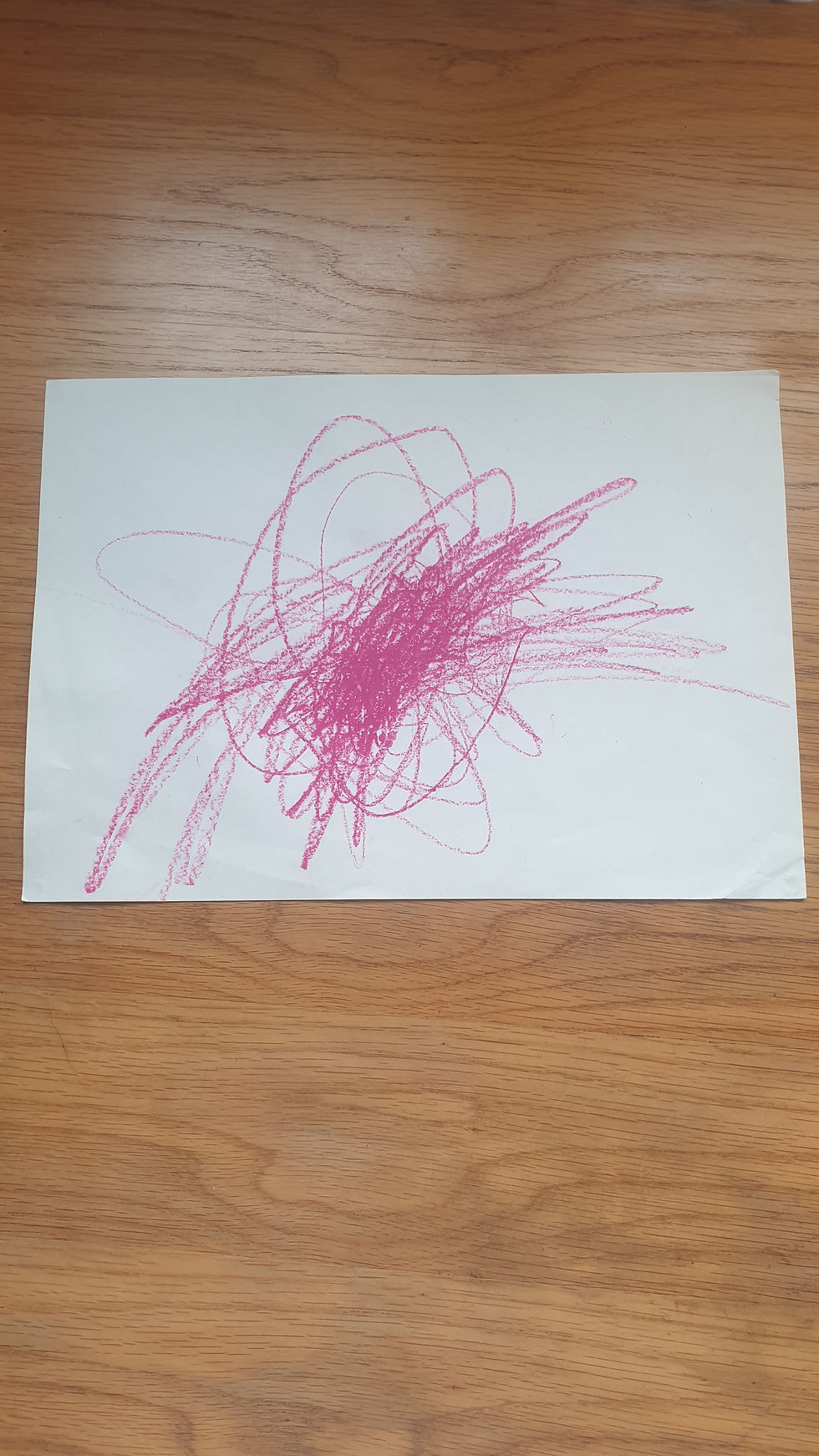
Nostalgically leafing through a portfolio of my daughter’s now ancient childhood paintings and drawings I was struck by the fact that I’ve always found children’s early *scribbles more aesthetically appealing and charming than their later representational efforts, and decided to explore how much significance they have, aesthetic and otherwise. Some clearly have more aesthetic appeal than others; for instance, I found the two below by my daughtert particularly appealing. That these scribbles are expressive of differing levels of aesthetic sophistication, richness of sensibility, and reality-apprehension amongst young children argues for nature over, or at least coterminous with, nurture, for some inborn talent and distinction.
Compared to other stages of the graphic activity of children those drawings produced between the ages of 2 and 4, what educationalists term ‘the scribble stage’, have been, I found, neglected by researchers, which implies to me a relative dismissal of the personhood of children of this age. In art history, although there is much material on children’s art, this stage is almost completely ignored, and books and papers dealing with the subject give the art of pre-school children passing mentions only. Classic works such as Jacqueline Goodnow’s Children’s Drawing and The Child as Thinker by Sarah Meadows dismiss it in a few lines, blithely accepting the view, promulgated earlier by Rudolf Arnheim in Art and Visual Perception, that such drawings are the result of mere ‘motor impulse’, lacking in all intentionality.
Commonly, people make parallels between children’s art and palaeolithic art, yet there is no concrete relation between the two. Just as we have no knowledge of a child’s interiority, we have no knowledge of the contexts of the in which Palaeolithic art was produced, nor of the inner worlds of its creators: these are things we’ll only ever be able to guess at, and they'll remain enigmatic. More importantly, the relationship between the infancy of human kind and that of humans is purely figural, despite its huge influence on modern art. Many artists influenced by primitive art were also influenced by children’s art, and the primitive and the childish conflated (in Totem and Taboo Freud conflated both with neuroticism). Responsible for this was Haeckel’s influential ‘recapitulation’ theory, whereby ‘ontogeny recapitulates phylogeny’, that is, the growing infant recapitulates the whole history of the species as it ages. This theory had currency for a long time and proved fruitful for art, despite being nonsense.
Surrealist art is also popularly linked to the art of young children, but this is down to a widespread, fundamental misunderstanding of surrealist automatism, which is derived from the free associationist principles of psychoanalysis, and almost always took the form of non-realist figuration. Even in the case of Andre Masson, we’re required to eventually recognise forms, and there is always at least one allusion to an image. Surrealism had a specific aim, to bring to the surface the unconscious, strongly linked to adult sexual desire. This is not to say that there is no autonomist element in young children’s artwork, it is just that it is not surrealist automatism. Even works by the Montreal Autonomists, who specifically linked their work with that of young children, was steeped in art history and theory. In his classic work Outsider Art Colin Rhodes demonstrates that young children’s art has nothing in common, either, with the art of the mentally disturbed, as some have tried to claim. To give one of his examples: the art of the mad almost always shows an obsession with covering the whole of the substrate, whereas with young children it never does.

Classical child psychology doesn’t provide any kind of intellectual substrate to ascertain the significance or otherwise of pre-schooler’s drawings, and offers only unempirical theorising. According to Melanie Klein, toddlers are in a permanent state of rage against their mothers. Later, the child will try to atone for her violent phantasies, and for Klein this atonement is the source of all artistic production. More appealing and convincing, Jean Piaget takes a Nietzschean/existentialist view in which early artistic activity is a processual record of pure becoming, with play and art essential for forming a robust ego with a capacity for self-making, rather than one formed largely by outside forces. For Donald Winnicott, the first few days or even hours of life are of the utmost importance for character development, and a paranoid or hypersensitive person may have been so from even the first few hours of life. He thinks that there is an innate agonistic tendency in the toddler but, unlike Klien, sees it as benign, necessary, an “original aggressiveness” that is synonymous for him with all meaningful activity.
In developmental psychology there’s a huge amount of attention given over to children’s figurative art, but it’s a given in this discipline that the artistic activity of 2-4-year-olds has no meaning beyond the pleasure of motor activity, and there’s an underlying assumption that the child has nothing to express. The consensus is that scribbling is a developmental precursor to the drawn line, which the child will abandon as soon as he or she is able. Further, it’s not just with representation per se with which researchers concern themselves, but solely with markers of progress towards the ability to draw the human figure, and the graphic element of all intelligence tests for small children are based around this goal.
This focus on the representational as the human figure is an ingrained prejudice among educators and child psychologists and a practical explanation for it may be the Classically-derived Renaissance ideas of beauty and precise verisimilitude that German art historian Wilhem Worringer discusses in Abstraction and Empathy. According to Worringer “... truth to nature and art gradually came to be looked at as inseparable concepts. Once this fallacious inference had been drawn it was a short step from regarding the real as aim of art, to looking upon the imitation of the real as the only valid art”, whereas for him, “the primal artistic impulse has nothing to do with the rendering of nature”, and it is the non-figurative that “allows the beholder and maker to escape from temporality”.

The most well-known and referenced texts in the field of children’s art are Georges Henri Luquet’s Children’s Drawing and Rhoda Kellog’s Understanding Children’s Art. Luquet sees children as little Kantians: “drawing is a game in which the child spontaneously applies the theory of the disinterestedness of art”. However, he doesn’t discuss pre-schoolers’ scribbles, which he dismisses as “... the simple effects of the spontaneous release of excess neuromuscular energy, and, since they are accompanied by pleasant feelings, the child is stimulated to repeat them”. He offers no empirical evidence for such a claim and often contradicts himself, for instance when he remarks that children are “natural realists” but shortly after lauds their consistent lack of realism in their use of colour.
For Luquet, the passage from scribbling to pictorial art comes through a process which he calls ‘fortuitous realism’, whereby a child accidentally produces figuration and then opportunistically builds upon it. Georges Bataille, in his review of Luquet’s book on cave art, supported this view, but also claimed that scribbling is essentially an act of destruction, transforming reality in an act of “primary aggression”, turning an object, and the self, into something new. This puts me in the mind of the fact that, artists aside, when adults scribble they in most instances scribble over something, to deface or obscure, often with some aggression.
Rhoda Kellog does make an advance on Luquet by ascribing to the little scribbler visual as well as motor pleasure, but still falls short of ascribing intention, expression, meaning, or affect to the child. She identified 20 basic scribble shapes collected over two decades. In crude brief she claims that single lines will later be used for outlines and that multiple lines will later become shading, in a natural development that will grow with increasing motor skills. At age three come ‘diagrams’ which have been preceded by ‘emergent diagram’ shapes, then ‘aggregates’, followed by ‘mandalas’. Basic scribbles eventually become ‘suns’, which naturally develop into faces, and after this comes figurative drawing proper. This approach is obviously highly schematic. Unaccountably Kellog, despite being serially discredited, has been and still is influential, yet only 2 per cent of her children drew the sun figures that she claims always precede human faces. All of her claims are based on similarly low percentages, and she ascribes so little agency to children that she claims there is “no choice in the placement of the scribble”.

A group of Italian researchers, Longobardi et al, produced **two very important and original papers in 2015 on the scribble-stage of drawing, important not just for developmental psychology and art history, but also for child protection. They wrote of Kellog that “... her vision of child art has remained a personal one, the results obtained from her studies have not been confirmed by later analysis.” Their research shows that the drawings of 2-4-year-olds can be used as “... early markers of child distress, or other emotional manifestations ... at least a year in advance as compared to classical graphical tests, which are not usually administered before the age of four”. In other words, toddler’s drawings may be used to detect abuse before a child is able to communicate about it verbally. Although drawings are commonly used to elicit information from children about abuse, as far as I know the findings of this research have not yet been acted upon in the area of child protection to pick up on abuse at an earlier age.
Their approach differs from that of previous researchers in that they ascribe a sophisticated intentionality and artistic judgement to a scribbling pre-schooler. Their general attitude is summed up thus:
“... the first scribbles appear during the second year of life, and not to recognise a form of intentionality in their production is the observer’s limitation and not theirs” and “... the emergence of mental representations and thus the ability to use a signifier to evoke meaning, would not seem to be compatible with an activity that stimulates the pleasure of mere exercise”.
Dismissing the idea of scribbling being “exclusively kinaesthetic, pure motor pleasure”, they offer instead a dynamic model of scribbling in which the scribble is always “expressive” of something. Young children, they found, “are not realists” and they argue that they perceive the world physiognomically, never have any intention of representing the formal aspects of reality, and wish to portray reality “as they perceive it” (as in the senses of both ‘how’ and ‘at the same time as’). "The hypothesis that the reason children begin to draw is their desire for graphical representation or pictorial figuration" they write, “does not allow researchers to evaluate correctly the meaning of scribbles or to reflect on the reasons that make them such a gratifying activity”. Children, in their view, are influenced by their animism: toddlers have little interest in the static qualities of objects, but are fascinated by their dynamic qualities, what they are doing, and why.
Initially, they say, the scribble “mediates the affective relationship between the internal and external worlds” and that the substrate is “a playground in which “the line animates the child’s fantasies and characters”. They identified marks that said ‘yes’ and marks that said ‘no’, lines that indicate caressing or hitting, and (emotionally) ‘good’ and ‘bad’ scribbles”:
“The line when perceived physiognomically as the act of caressing and hitting ideally represents the child’s relationship with events and objects of the external world through two types of traces: good traces, round and soft, and bad traces, heavy and disorganised ... these kinds of traces, round in one case, broken in another, not only express an action per se, but most of all they express the good or bad quality of the action in itself”.
If these researchers are correct, the child is making a pure moral judgement with their marks: this pleases/displeases, this harms/gratifies. They call this ‘moral aestheticism’ and argue that it dominates the whole of the scribble stage: “... lines can be fast, slow, sad, happy, they can walk or run ... lines express emotional states like sadness, happiness, melancholia etc. because they reflect them and, in a way, embody them, because children see them as intentional and living”.
These researchers claim that the child’s fascination with the dynamic properties of objects can be seen most clearly in onomatopoeic scribbling, whereby a trace is accompanied by onomatopoeic sounds made by the child as he or she draws. They see an end to the scribble stage as a necessary, natural loss, although they concede that there is pressure on children to draw ‘real’ objects. In their view “...children spontaneously abandon the scribble, which is a dynamical representation of an object, in favour of figurative schemas, that better suit their creative need to no longer just represent reality, but to make it real”.
Scribbling is something they describe as a ‘graphical monologue’ serving the same self-constituting function as babbling, that likewise must come to an end (the ends of all these stages are tragic for a parent, just as the emergence of new ones are joyous). The world the child leaves behind is one of dynamism and movement, and in their early years they do not draw what they know thus far of reality, nor what they see, but they choose rather to “choose to draw experience”. The intention behind a scribble is to give an ontological, not a physical likeness, of both self and world simultaneously.
Much of the above could be applied to the work of artist Cy Twombly, the artist most associated with scribbling. That elements of paintings such as scribbles, line pressure, flurries and so on could be used to identify a history of strong emotion, distress, grief or joy in the work of an adult artist is beyond question; scribbled parts of a painting can be found many works by many artists, and scribbling is one mode of shading. There are works of Twombly that according to his biographer were produced in periods of grief and distress where he seems to have reverted to a childish state and using scribbles in an infantile way, but, however raw the emotion, with adults this can only seem so.
Critic Richard Leeman said of Twombly’s work that his “scribbling is “... the embryonic semiosis of the moving flux of the psyche”, whilst John Bird said that “... what the viewer beholds are the encoded memories of the body’s experiences ... a Heraclitean flux that simultaneously registers the body’s pulsions and the mind’s cognition”. Both, perhaps, somewhat gnomic justifications. Like Roland Barthes previously, Bird attempted to copy one of Twombly’s abstract, scribble-like crayoned works and, like Barthes, found it impossible. This is because neither were trained artists, and do not have Twombly’s particular sensibility. By the same token, Twombly is no child, and his work bespeaks a whole personal, emotional history, and is steeped in a sophisticated engagement with art history, as well as his awareness of politics, literature, philosophy, time and mortality. As Colin Rhodes put it in Outsider Art:
“Unenlightened criticism of modern Western art often confuses of perceived similarities with children’s drawings. Yet, the economy of means and apparent spontaneity achieved in the work of trained professionals does not signal a continuation of childhood, but of recovery at a highly sophisticated level of certain childish features."
Some disparage abstract art by saying “a child could do that”, but it would be equally incorrect to say of a child’s scribble, “an adult could do that”, because no artist, however talented, can ever again inhabit a toddler’s lifeworld and regain such nonchalant sprezzatural abandon. Conversely, the child’s scribble, though expressive of affect and a rich inner life, is lacking in all intellectual content, is uninflected by memory and experience, uninformed by a long emotional history, and have no relationship to the history of art. Although to a limited extent they can be discussed in formal aesthetic terms they can never be part of the ‘Artworld’ as defined by philosopher Arthur C Danto in his epochal essay The Artworld. Infant scribbles will be more appealing to those who already enjoy abstract art, and also to those who are parents, as looking at them transports you back to a brief and magical period of your child’s life, perhaps even to the occasion of that particular work’s production. As a form there can be infinite variations upon the young child’s scribbles, but no progress; they exist in a kind of temporal vacuum, which is what constitutes their beauty.
Our child’s scribbles ‘touch’ us, and when we are thus touched it’s in part because we experience a nostalgia for an irrevocable state of being, an almost-remembered, almost-recognised lost state of infantine wholeness, an unmediated relation to the world. These drawings and paintings (at this age the child uses the paintbrush as a drawing tool) are the lifeworld of the toddler made manifest, within which they’ve barely nibbled at the tree of knowledge, and are not yet memory’s prey, or time’s food. When an adult artist recovers something akin to this state whilst creating, it is not a going-beyond, but a falling-back-into. They are works of imagination, too, but come from an imaginative world to which we have no access, and which the child has no other way to communicate; by the time they do have that capacity, they will have already outlived and forgotten it. The inner world of a child is, in Piaget’s words, “an abyss of mysteries”. All abysses, however, are sublime, and it is this abyssal sublime that looks back at us when we look at our child’s scribbled drawings.
*A scribble is that it is something of which people hold a representative example in their heads to which they naturally refer to when they read or hear the word, and which has almost the status of a Gestalt. This is different from when one writes or says ‘drawing’ or ‘painting’: here, one must refer to a particular drawing or painting and we don’t hold in the mind a kind of ‘ur-drawing, ur-painting. The etymology of scribble’ has nothing to do with graphology or with the Latin root ‘scribere’, ‘to trace characters’, but derives from the world ‘scribble’, used, according to Onion’s Etymological Dictionary, for the first time in 1682, meaning ‘to card or tease wool coarsely through a scribble; a person who scribbles wool’. We call a scribble a scribble because of its resemblance to tangled, looped strands of wool after being carded.
**Reconsidering the Scribbling Stage of Drawing: a New Perspective on Toddlers' Representational Processes, Claudio Longobardi; Rocco Quaglia; Nathalie O Lotti (Frontiers in Psychology, Volume 6, Article 1227)
and
A New Theory of Children's Drawing: Analysing the Role of Emotion and Movement in Graphical Development, Claudio Longobardi; Rocco Quaglia; Nathalie O Lotti, Laura E Prino (Infant Behaviour and Development 39 (2015), pp. 81-89.
†Actual abuse aside, the child’s world is far from one of permanent jouissance, in some cases, unfortunately, very far from such a state. As Elias Canetti points out in his startling discussion of childhood and the psychopathologies of adult domination in Crowds and Power, the young child is subjected to an incessant stream of sometimes bewildering commands, some given in a spirit of malice or sadism.

Comments