Nuclear Catastrophe and British Television: Threads and The War Game
Updated: Aug 25

Threads
“After all, what acte gratuit, what vulgar outrage or moronic barbarity can compare with the black dream of nuclear exchange”
Martin Amis, Einstein’s Monsters
Threads (1984) is a television film that went against the grain of the medium itself, one of its very rare masterpieces, and one impossible to watch and be left unshaken. The feature-length drama portrays the build up to a nuclear attack on Britain, the attack itself, and its aftermath. It was commissioned by the Director General of the BBC, Alistair Milne, after he watched Peter Watkins’s earlier BBC film about a nuclear attack on Britain, The War Game (1966), ironic, as it was one of his predecessors, Sir Hughe Greene, who had banned that film for almost twenty-years. What makes Threads so impressive is that with an anti-spectacular, excruciating realism, it presented TV audiences with harrowing, unameliorated truths, something rare for a television audience to encounter, then or now. Directed by Mick Jackson (A Very British Coup, 1998, The Ascent of Man, 1973) and scripted by Barry Hines (Kes, 1969), Threads was nominated for seven Baftas and winning four, it showed that aesthetically exhilarating masterpieces can be produced with minuscule budgets (£400, 000 in this case, not even £1.5 million in today’s money) if the talent, integrity and institutional support are there.
The film was almost obsessively researched by Jackson. The after-effects of nuclear war a were a part of public discourse at the time, and the anti-nuclear movement vocal and strong – there was a slew of documentaries such as the 1982 QED episode A Guide to Armageddon (produced by Jackson) and the Panorama episode If the Bomb Drops (1980), detailing what would happen following an attack. Two years before Threads, Jonathon Schell’s The Fate of the Earth had been published, an influential wake-up call detailing everything that would happen to humanity and the earth following a nuclear exchange.

Threads opens like a traditional soap-operatic family drama, something akin to 1973's popular ITV series A Family at War, with young Sheffield couple, working-class Jimmy Kemp (Reece Dinsdale) and the more bourgeois Ruth Beckett (Karen Meagher) finding themselves unexpectedly parents-to-be, planning their marriage, and moving into a new flat. We follow their lives, and that of their parents, neighbours, colleagues and friends, and later that of a Council member, Clive Sutton (Harry Beety) the city’s ‘designated wartime controller, as the tense build up to a nuclear attack (triggered by a conflict between Nato and the Warsaw Pact after the Soviet invasion of Iran) is depicted through newspaper headlines, radio and television reports, conversations, scenes of jets flying overhead, and brief clips of activity at military bases.
Masterfully edited, the live action is intercut with black and white stills, and throughout the film there are terrifying facts and statistics about the realities of a nuclear attack presented on intertitles and through voiceovers. These documentary interventions act as distancing effects that paradoxically increases the emotional impact of the drama, and the clipped speech and sober, impartial tone of the voiceovers disorientingly contrast with the increasing horror of the images and the statistics related.

The breakdown of civil society begins even before the attack, and overnight money loses all meaning. Forty-seven minutes into the film an 8-megaton thermonuclear bomb is detonated above the North Sea, then there's a near-direct his that destroys Sheffield, and a final 3000 megaton exchange that ushers in a global nuclear winter. The next hour and ten minutes of the film are concerned with the aftermath: firestorms, hurricanes, mass fatalities, the total collapse of civil society, starvation, looting, summary executions, madness, typhoid, dysentery, and cholera epidemics, people puking their lives out with radiation sickness, and a return to a pre-medieval subsistence society in a dark, cold, blighted world where little grows.
There are no dramatic palliatives: every character bar Ruth soon dies a horrible death, and after the blast Jimmy dies before finding her. Ruth’s parents are murdered by looters, the luxury of their basement affording them only a few more days of life than the door propped against a wall that Jimmy’s parents cower beneath. Councilor Sutton suffocates in a bunker beneath the Town Hall with his colleagues, having achieved nothing. The authorities, starving themselves, turn against the population, looting the looters. Part of an exodus from the city in search of food, Ruth gives birth to her daughter Jane in a filthy outhouse, biting through the umbilical cord. We’re told in a voiceover that, due to radiation, “there is a high risk of deformity and mental retardation”. Thirteen years after the blast she dies, her eyes covered in cataracts, as her teenage daughter Jane (Victoria O’Keefe) affectlessly tries to wake her – “Ruth.Up. Ruth. Work” she says in her denuded language. The film ends with Jane in turn giving birth in a makeshift hospital, with a look of horror and terror on her face as she's handed the abomination she has birthed.
The War Game
Before Threads there was Peter Watkins’s The War Game, but a television audience didn’t get to see it until 31 July, 1985, the night before a re-screening of Threads to mark the 40th anniversary of the bombing of Hiroshima and Nagasaki. In Watkins's film the catastrophe is the result of a conflict between the West and the Communist bloc after a Soviet invasion of West Berlin following fighting in South Vietnam.The War Game, which used non-professional actors, is filmed as a faux-documentary in the style of news magazine programmes of the period, with plummy-voiced interviewers, hand held cameras, vox pops with citizens before and after the nuclear attack, and is also intercut with factual intertitles and voiceovers. As as with Threads music is eschewed, and here there is no initial focus on families or individuals with whom an audience can empathise. After a one megaton thermonuclear bomb incinerates Kent, we agan see an immediate decline into savagery: coups de grace administered by the police, firing squads, gas poisoning, starvation, blindness, and piles of corpses being burned.
There was less known about the effects of nuclear war in 1966, with almost no public awareness, and a voice over informs us that: “on almost the entire subject of thermonuclear weapons and the problem of their possession and the effects of their use there is now practically total silence in the press, in official publications, and on television” – a far cry from the mid-1980s when it was a dream-haunting cultural obsession. The War Game was also heavily researched but it was the effects of the carpet bombing of Dresden and the concomitant firestorms that most informed the film, and documentary footage from Dresden is included in it: “everything you are now seeing” the narrator tells us, “happened in Germany after the heavy bombing of the last war”.
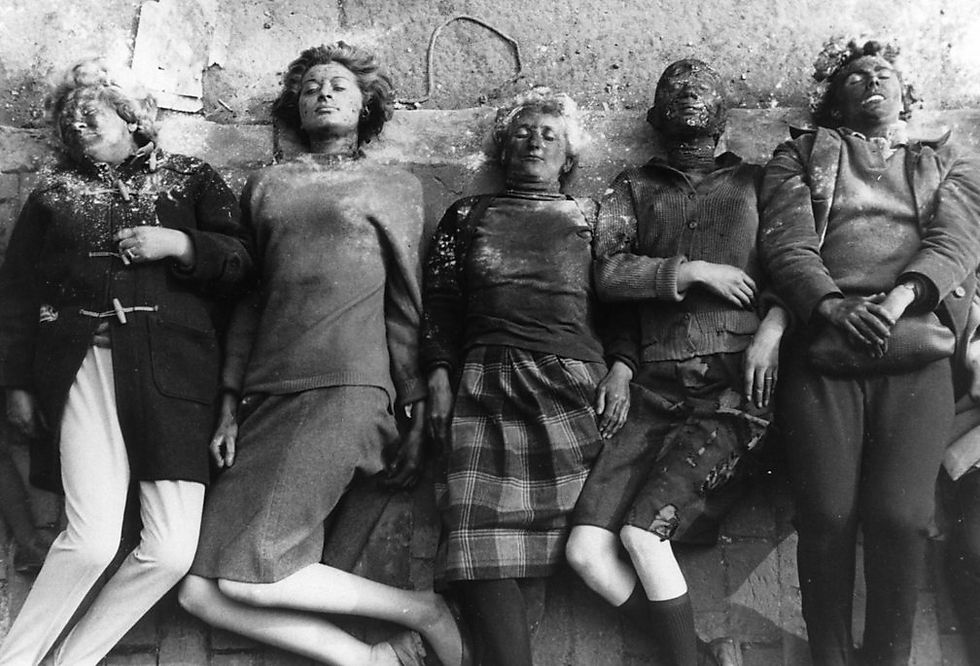
Peter Watkins was a golden boy at the BBC following the success of his innovative historical drama Culloden (1964) which used the conceit of a contemporary news team covering the 1764 Battle of Culloden, garnering him a British Screen Writers’ Guild Award. But The War Game, due to be shown on the BBC on 06 October 1965, was withdrawn from screening on the grounds that “it was too horrifying for the medium of broadcasting” following a private screening for members of the Cabinet Office, Home Office and Ministry of Defense. The ban resulted in Watkins resigning from the BBC and his lifelong self-exile from the UK.
The War Game ran from April to May 1966 at the BFI, won a Special Prize at the Venice Film Festival and an Oscar for Best Documentary Feature in 1967, none of which was enough for the BBC to consider screening it for another two decades. The Chairman of the BBC’s Board of Governors at the time, Lord Normanbrook, was the former Cabinet Secretary responsible for government planning during a nuclear war, which is presented in the film as shambolic. Watson didn’t only criticise government planning, but also included short interviews with actors portraying members of the ever-rotten British establishment speaking in favour of nuclear weapons, which were however taken verbatim from actual interviews. The depiction of people not being able to afford the materials for a bomb shelter, and the speed at which an exploitative black-market economy grows up during rationing were seen as critiquing capitalism (instead, the latter inadvertently suggested something eternal about human nature, and there is more of Hobbes than Marx).
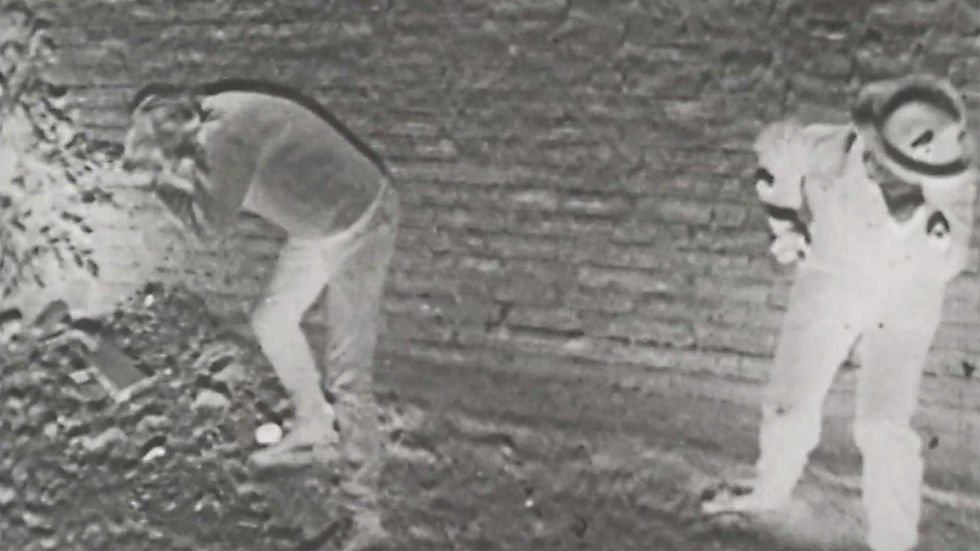
There was also implicit criticism of British conduct towards German during the war, especially the carpet bombing of some of its cities. This was likely to have alienated some of the public, many of whom had lost people in the war, and had lived through The Blitz, and the bombings and firestorms in other cities, themselves. This agitprop element of the film weakens it aesthetically, making it a less powerful film than Threads. Minor aeshtetic flaws, however, don't justify the banning what was nevertheless a powerful, innovative and necessary movie. The idea that it was “too horrible for the medium”, considering the context of the film’s withdrawal and who was involved, doesn’t wash: the ban was an establishment stitch up with potential opposition to bellicose foreign policy, nuclear proliferation, and the spending on it, in mind.
The Cold War was effectively over by 1989, communism gone by 1992, and fears of a possibility of a nuclear exchange between the Superpowers dissipated almost to nothing by the beginning of the nineties. Yet in 1984 the Bulletin of the Atomic Scientist's 'Doomsday Clock' stood at four minutes to midnight (that is, Armageddon), whilst today it stands at just 85 seconds to midnight*, and the organisation says that “humanity is living on borrowed time”.
The US and Russia now have significantly fewer warheads, yet still enough to kill the inhabitants of the earth several times over. Although full global disarmament is supposedly the eventual aim of The Treaty on the Non-Proliferation of Nuclear Weapons, it includes no processes to achieve it. There are now new dangers presented by AI, which could prove to be the final instantiation of our hubris, and it seems unlikely that it won’t make it into the nuclear industry, and into the military as far as nuclear command and control.
Threads and The War Game are rare films in that they are not merely ‘still relevant’, but are significantly more relevant and necessary now than when they were first screened. The world is a much more unstable place than it was in then, the chances of both nuclear war and accident are much higher, and a nuclear war would make climate change an irrelevancy.
********************************************
*The main culprit for us being so close to ‘midnight’ is Pakistan, a chaotic country whose intelligence, military, and civilian leaders share power with the unseen hand of Islamic militants, and responsible for the nuclear proliferation of other countries not recognized as Nuclear States. In 1990 and 2019 Pakistan and India came closer to a nuclear exchange than the US and the Soviets did in 1962 over the Bay of Pigs, in disputes over Kashmir, which remains a flashpoint. The Commission on the prevention of Weapons of Mass Destruction has stated that “when you map Weapons of Mass Destruction and terrorism, all roads lead to Pakistan”.
Dr Abdul Qader Khan, the ‘Father of the Pakistani Nuclear Bomb’ did more than any other man to increase the danger of a nuclear war. In the 70s he built Pakistan’s nuclear weapons programme in secret after stealing plans for a centrifuge to create weapons grade plutonium whilst working for URENCO in Amsterdam. He sold plans for centrifuge design to Iran in 1997 for $3m, and in 1992 traded missile technology for uranium enrichment technology with North Korea. In 2004 Khan was put under house arrest and went on live television confessing to an international black market in nuclear materials and to enabling nuclear proliferation to Iran, North Korea and Libya. He died in 2021.


Comments